

What if the cover you expect to protect your new home only applies in specific circumstances? Getting builder warranty insurance explained means understanding that it’s a jurisdiction-based safety net, not a promise of defect-free work. It may help if a builder dies, disappears, becomes insolvent or, in some schemes, can’t or won’t fix an issue. The rules and claim triggers depend on where you’re building.
It’s reasonable to want clear answers before signing a contract or paying a deposit, especially if you’re unsure what happens if your builder can’t complete your home. This guide explains what the cover may and may not do, and what to verify for your state or territory.
We’ll outline how schemes differ across Australia, explain how insurance relates to statutory warranties, and show you which regulator and documents to check. You’ll also find practical questions to ask as you assess your new-build plans.
Key Takeaways
- Get builder warranty insurance explained in the context of your state or territory, because scheme names, eligibility and claim triggers differ.
- Check which builder-failure events may qualify for protection. Don’t assume ordinary defects or contract disputes are covered.
- Confirm the applicable scheme and required insurance evidence with the relevant regulator or authorised body before signing.
- Compare the insurance documents with the contract, builder details, scope, inclusions and variation terms.
- Use insurance checks as one part of assessing a new-build package, not as a substitute for broader due diligence.
Builder warranty insurance explained: what it is and why it matters
In plain English, builder warranty insurance is scheme-based cover that may provide eligible protection if a residential builder can’t meet specified obligations. The scheme name, eligibility rules, claim triggers and benefits depend on the state or territory and the policy. There’s no single national scheme, so this definition isn’t a substitute for the wording that applies to your project. Check the relevant regulator or authorised body for current legal and policy terms.
This cover matters because a builder’s failure can leave homeowners facing unfinished work or unresolved problems. But insurance isn’t a guarantee that the home will be defect-free, nor does it automatically cover every defect, delay or contract disagreement. Treat it as a possible safety net under defined conditions, not as a replacement for checking the contract or assessing building quality.
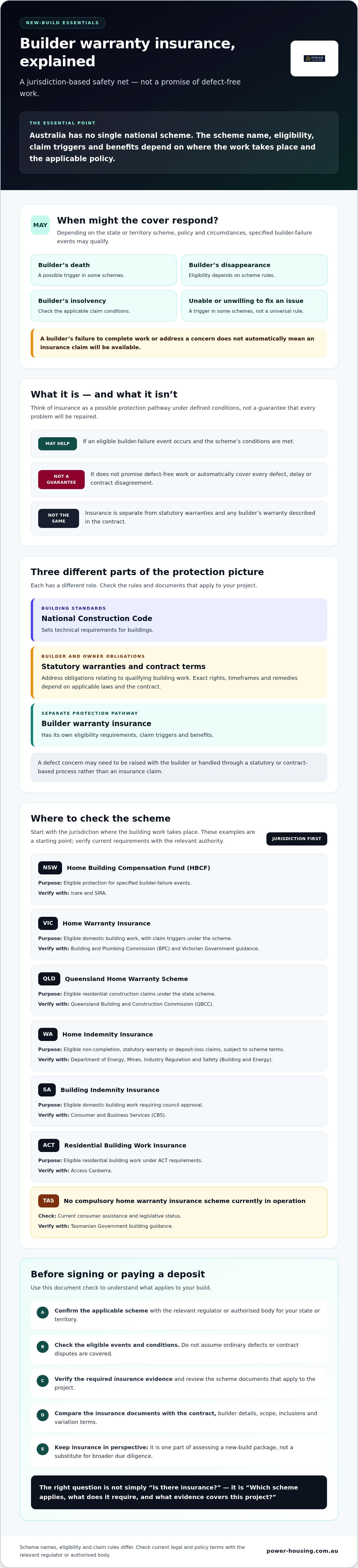
Builder obligations also sit within a broader framework. The National Construction Code sets technical requirements for buildings, while statutory warranties and contract terms address obligations between the builder and owner. Exact rights, timeframes and remedies depend on applicable laws and the contract. The insurance scheme is a separate protection pathway, with its own eligibility and claim rules.
What does builder warranty insurance generally protect?
Depending on the jurisdiction, a scheme may respond to specified events such as a builder’s death, disappearance or insolvency. Other schemes may have different triggers. Eligibility can depend on the circumstances, the work and the policy.
Check the scheme documents before relying on a particular event or benefit. A builder’s failure to complete work or address a concern doesn’t automatically mean a claim will be available.
Is builder warranty insurance the same as a defect warranty?
No. Statutory warranties generally set legal obligations for qualifying building work, including obligations relating to defects or incomplete work. A separate builder’s warranty may also be described in the contract. Insurance is different: it may provide protection only when the scheme’s specified conditions are met.
A defect concern may need to be raised with the builder or addressed through a statutory or contract-based process, rather than an insurance claim. Review your contract and ask the relevant regulator what applies before choosing a pathway. Getting builder warranty insurance explained in these terms helps you identify what to verify without mistaking cover for a promise to repair every problem.
How builder warranty insurance works across Australian states and territories
The state or territory where the building work takes place determines which scheme to check first. Australia has no single national builder warranty insurance scheme. Names, administrators, eligibility, claim triggers and cover differ. Use the examples below as a starting point, then check the current rules for your project.
| Jurisdiction | Scheme or regulator | Typical purpose | Official verification route |
|---|---|---|---|
| NSW | Home Building Compensation Fund (HBCF); icare | Eligible protection for specified builder-failure events. The linked icare information outlines the NSW scheme. | icare’s HBCF guidance and SIRA |
| Victoria | Home Warranty Insurance; Building and Plumbing Commission (BPC) | Eligible domestic building work, with claim triggers under the scheme. | BPC and Victorian Government guidance |
| Queensland | Queensland Home Warranty Scheme; QBCC | Eligible residential construction claims under the state scheme. | Queensland Building and Construction Commission (QBCC) |
| Western Australia | Home Indemnity Insurance; Building and Energy | Eligible non-completion, statutory warranty or deposit-loss claims, subject to scheme terms. | Department of Energy, Mines, Industry Regulation and Safety |
| South Australia | Building Indemnity Insurance; Consumer and Business Services (CBS) | Eligible domestic building work requiring council approval. | Consumer and Business Services |
| ACT | Residential Building Work Insurance; Access Canberra | Eligible residential building work under ACT requirements. | Access Canberra |
| Tasmania | No compulsory home warranty insurance scheme currently in operation | Check current consumer assistance and legislative status. | Tasmanian Government building guidance |
| Northern Territory | Fidelity Fund Certificate; Northern Territory Government | Applies to prescribed residential work where requirements are met. | Northern Territory Government building guidance |
Which regulator or scheme applies to your build?
Start with the regulator for the state or territory where the work will take place. For example, NSW buyers can check the Home Building Compensation Fund (HBCF) information from icare. In Victoria, the scheme for eligible new contracts from 1 July 2026 is called Home Warranty Insurance and is administered by the BPC. In Queensland, the QBCC administers the Queensland Home Warranty Scheme.
Why does the project and contract matter?
Location is only the first check. Project type, contract value, builder eligibility and the precise scope of work can affect whether cover is required and what protection may apply. Thresholds, exemptions and claim rules also vary and can change. Confirm that your specific contract and work qualify, then verify the insurance evidence with the regulator or authorised body before relying on it.
Getting builder warranty insurance explained means starting with the right jurisdiction, then checking the details of your own build. As you work through those checks, you can also explore tailored house and land package coordination as part of shaping your new-build plans.
What builder warranty insurance covers - and what it may not
Builder warranty insurance is designed around defined events and conditions, not every problem that can arise during a build. Whether a situation qualifies depends on the scheme, policy, contract and available evidence. Read the current policy wording and regulator guidance before relying on a particular benefit, exclusion, claim limit or notification deadline.
Some schemes focus on last-resort events, such as a builder’s death, disappearance or insolvency. Victoria’s Home Warranty Insurance scheme, which commenced on 1 July 2026, also allows claims where an eligible builder is unable or unwilling to fix issues. These are jurisdiction-specific examples, not a promise that a similar claim will qualify elsewhere.
When might a claim be available?
A claim may be considered when the event and building work meet the scheme’s eligibility rules. For example, NSW’s Home Building Compensation Fund may respond to specified builder-failure events, while Victoria’s scheme has broader claim triggers. In either case, the buyer must follow the formal process and provide the required evidence. Lodging a claim doesn’t guarantee acceptance, payment or a particular remedy.
| Situation | How to think about it |
|---|---|
| Builder dies, disappears or becomes insolvent | Scheme-dependent: may be a claim trigger under some schemes, subject to eligibility and evidence rules. |
| Builder is unable or unwilling to fix an issue | Scheme-dependent: Victoria’s Home Warranty Insurance scheme includes this trigger; don’t assume it applies in other jurisdictions. |
| Defective workmanship or incomplete work | Not automatically covered: check whether the issue meets the scheme’s specific claim conditions or requires a separate statutory warranty or contract process. |
| Delays, cost overruns or contract disagreements | Not automatically covered: these may need to be addressed through contract or dispute-resolution pathways. |
What should not be assumed to be covered?
A policy isn’t a blanket defect warranty. Don’t assume it will pay for every workmanship concern, delay, extra expense or disagreement with the builder. Even where a claim trigger exists, exclusions, limits and deadlines can affect the outcome. The applicable documents and regulator guidance determine the details.
Keep inspecting and documenting the build. Save contracts, variations, correspondence, photographs, reports and notices, and record issues promptly. Insurance doesn’t remove the value of careful checks or clear records. If you’re unsure whether a problem belongs under insurance, a statutory warranty or your contract, confirm the correct pathway with the relevant regulator before acting. The practical value of having builder warranty insurance explained clearly is knowing what to verify, rather than assuming every problem has the same remedy.
How to check builder warranty insurance before signing or building
Before signing or paying a deposit, confirm which scheme applies and whether the specific work is eligible. A builder’s assurance or a document attached to a quote isn’t a substitute for checking the evidence independently. Use this checklist to spot mismatches early and decide what to ask next.
- Identify the scheme. Contact the regulator or authorised body for the state or territory where the work will take place. Ask which scheme and rules apply to your project.
- Confirm eligibility. Check whether the project type, contract value, builder and scope of work meet current requirements. Ask about any relevant thresholds or exemptions.
- Get the insurance evidence. Request the certificate or other required proof of cover. Confirm the policy dates, insured parties and any required notices or waiting periods with the relevant authority.
- Match the details. Check that the builder’s legal name, project address, contract and covered work align with the signed agreement. Ask for clarification if names, dates, scope or other details differ.
- Verify it independently. Contact the regulator or authorised body using its official details. Confirm the evidence is valid for this project, and ask how to check claim steps, exclusions and notification deadlines.
- Keep a complete record. Store the contract, certificate, payment records, variations, notices and written communications together. Keep copies of updated documents as the project changes.
Documents and details to verify
Review the certificate alongside the signed building contract, not in isolation. Check the policy period and parties named, then compare the project address and work description with the contract. If a variation changes the scope, ask whether the insurance evidence needs to be updated. Confirm any notice requirements, waiting periods or claim deadlines directly with the regulator or authorised body.
Questions to ask your builder and regulator
Ask your builder which scheme applies, what evidence you should receive and how you can verify it yourself. Then ask the regulator which events, exclusions and claim steps apply to your particular project. If the contract wording or insurance evidence remains unclear, consider obtaining independent legal advice before proceeding.
Confirm the cover directly before relying on it or proceeding with the work. Getting builder warranty insurance explained is a useful starting point, but checking the project-specific documents turns general information into practical due diligence. If you’re also shaping the wider build, explore tailored house and land packages as part of your planning.
Use insurance checks to make a more confident new-build decision
Insurance due diligence is one part of choosing a new build, not a substitute for reviewing the whole agreement. Look at the contract scope, inclusions, variation process, builder details and insurance evidence together. A mismatch between the named builder, covered work and contract details is a reason to pause and ask for clarification before committing.
Understanding builder warranty insurance explained can help you frame the right questions, but the scheme administrator or regulator is where to confirm policy rules and evidence. Keep insurance checks separate from decisions about your package design or land. Both matter, but they answer different questions.
Bring the right questions into your package discussion
Before you commit, establish who the contracting builder is and which state or territory’s rules apply to the work. Ask what insurance evidence will be provided, how you can verify it independently, and who is responsible for confirming that the documented project matches the contract. Get answers in writing where possible, and resolve unclear details before signing or paying a deposit.
For a broader contract review, compare:
- the builder’s legal name and the parties named in the contract and cover documents
- the work included, exclusions, specifications and process for approving variations
- the project address and whether it matches the insurance evidence
- who to contact for scheme questions, claims guidance or a dispute.
Know when to get specialist help
If you’re uncertain about policy wording, eligibility or a potential claim, contact the relevant scheme administrator or regulator. For complex contract clauses or disputed coverage, consider independent legal advice. A package or design discussion shouldn’t be treated as insurance advice, and insurance confirmation shouldn’t be confused with guidance about land selection or home design.
Power Housing coordinates tailored house-and-land packages and provides custom home design assistance. Once you’ve identified the insurance questions to verify independently, you can explore package options as a separate part of planning your build. Take the next step at your own pace: Explore tailored house and land options.
Take your next build step with clarity
Builder warranty insurance explained comes down to three practical checks: identify the scheme for your state or territory, confirm what events it may cover, and verify the project-specific evidence before you commit. It’s a safety net with defined limits, not a guarantee of defect-free work or a replacement for reviewing your contract.
Consider the insurance documents alongside the builder’s details, project scope, inclusions and variation terms. If policy wording or contract responsibilities aren’t clear, ask the relevant scheme administrator or regulator, and consider independent legal advice where needed.
With those checks underway, you can focus on shaping the home and package that suit your plans. Power Housing coordinates tailored house-and-land packages and provides custom home design assistance for customers nationally across Australia. It doesn’t arrange insurance, so confirm cover directly with the relevant authority.
Explore tailored house and land options and take your next step with informed questions and a clearer view of your build.
Frequently Asked Questions
What is builder warranty insurance in Australia?
Builder warranty insurance is jurisdiction-based cover that may help homeowners if a residential builder can’t meet specified obligations and the claim meets scheme rules. In Australia, builder warranty insurance explained means understanding that the scheme’s name, eligibility, claim triggers and limits depend on where you’re building. It isn’t a national guarantee of defect-free work. Check your state or territory regulator’s current guidance and the policy documents for your project.
Does builder warranty insurance cover defects?
Not necessarily. Some schemes may respond to eligible defects in specific circumstances, such as when a builder is insolvent or otherwise meets a scheme’s claim trigger. Ordinary workmanship concerns may instead need to be raised under statutory warranties, the building contract or a dispute process. Don’t assume every defect is insured. Check the policy wording and ask the relevant regulator which pathway may apply to your circumstances.
Is builder warranty insurance compulsory in Australia?
There’s no single national requirement. Several jurisdictions require cover for eligible residential building work above a specified threshold. For example, NSW generally requires HBCF cover for residential building work valued over A$20,000, while Queensland’s threshold is over A$3,300. Tasmania has no compulsory home warranty insurance scheme currently in operation, according to the supplied September 2026 research. Confirm current requirements, thresholds and exemptions with your state or territory regulator.
What happens if my builder goes bankrupt?
Contact the scheme administrator or regulator for the jurisdiction where the work is located and ask how to notify them and make a claim. Insolvency may be a claim trigger under some schemes, but eligibility, deadlines, evidence and possible outcomes vary. Keep your contract, insurance certificate, payment records, correspondence and details of incomplete or defective work together. Don’t assume a claim will be accepted or that it will pay for every loss.
How do I check if my builder has warranty insurance?
Ask the builder for the certificate or other required evidence of cover, then verify it directly with the relevant regulator, insurer or authorised body. Check that the builder’s legal name, project address, contract and covered work match your signed agreement. Confirm policy dates, eligibility and any notification requirements. Keep copies of the evidence and written confirmation. If details don’t match, ask for clarification before signing, paying a deposit or proceeding with work.
Is builder warranty insurance the same across every Australian state?
No. Australia has separate state and territory arrangements, with different scheme names, administrators, eligibility rules, coverage triggers and limits. For instance, NSW has the Home Building Compensation Fund, Queensland has the Queensland Home Warranty Scheme, and Victoria’s Home Warranty Insurance scheme commenced for eligible new contracts from 1 July 2026. The relevant regulator can confirm which rules apply to your project. Don’t rely on another state’s scheme details.
Can I claim on builder warranty insurance for unfinished work?
Possibly, if the circumstances and work meet the applicable scheme’s eligibility and claim requirements. Some schemes may provide protection for eligible non-completion, but the trigger and process aren’t the same across Australia. Contact the scheme administrator or regulator promptly to ask what steps and evidence are required, and check any deadlines in your policy documents. Keep records of progress, payments, notices and communication with the builder.


