

Could the first home buyers grant help you build sooner, or might another scheme better suit your plans? In Australia, support varies by state and territory. A grant is not the same as a low-deposit scheme or a stamp duty concession, and what applies depends on your circumstances and the home you plan to buy.
It’s understandable to feel unsure. Previous property ownership, residency, the type and value of the home, and your plans to live in it can all affect eligibility. Grant amounts and rules can change, so information that applied in another jurisdiction or last year may not apply to your purchase in 2026.
This guide explains how the First Home Owner Grant differs from federal deposit assistance and other concessions. It covers eligibility questions, documents to prepare and the application process. You’ll also learn why grant research belongs alongside decisions about land, design and construction. With a clearer picture of possible support, you can plan your next steps and consider how a tailored house and land package or custom home design could fit your goals.
Key Takeaways
- Find out which state or territory rules apply to your planned purchase before relying on assistance.
- Use the first home buyers grant eligibility questions to identify the ownership, residency and property details you’ll need to investigate.
- Compare grants with stamp duty concessions, deposit guarantees and shared equity to understand what each type of support is designed to do.
- Check the application pathway and required documents, then verify the current rules before signing a contract.
- Factor potential assistance into your wider land, design and construction plan, but budget for the project without treating a grant as guaranteed funding.
What is the first home buyers grant in Australia, and who provides it?
The First Home Owner Grant (FHOG) is a state or territory government payment for eligible first-home buyers. The jurisdiction where the home is located sets and administers the rules. The grant is intended to support qualifying purchases or builds, but eligibility, amounts and application processes differ across Australia.
The scheme began as a national initiative, but its current operation is jurisdiction-specific. For a brief background, see this overview of First Home Owners Grant history. Today, there is no single national application or one set of rules for every home. The relevant state or territory revenue authority publishes the current criteria and process.
Is the First Home Owner Grant the same across Australia?
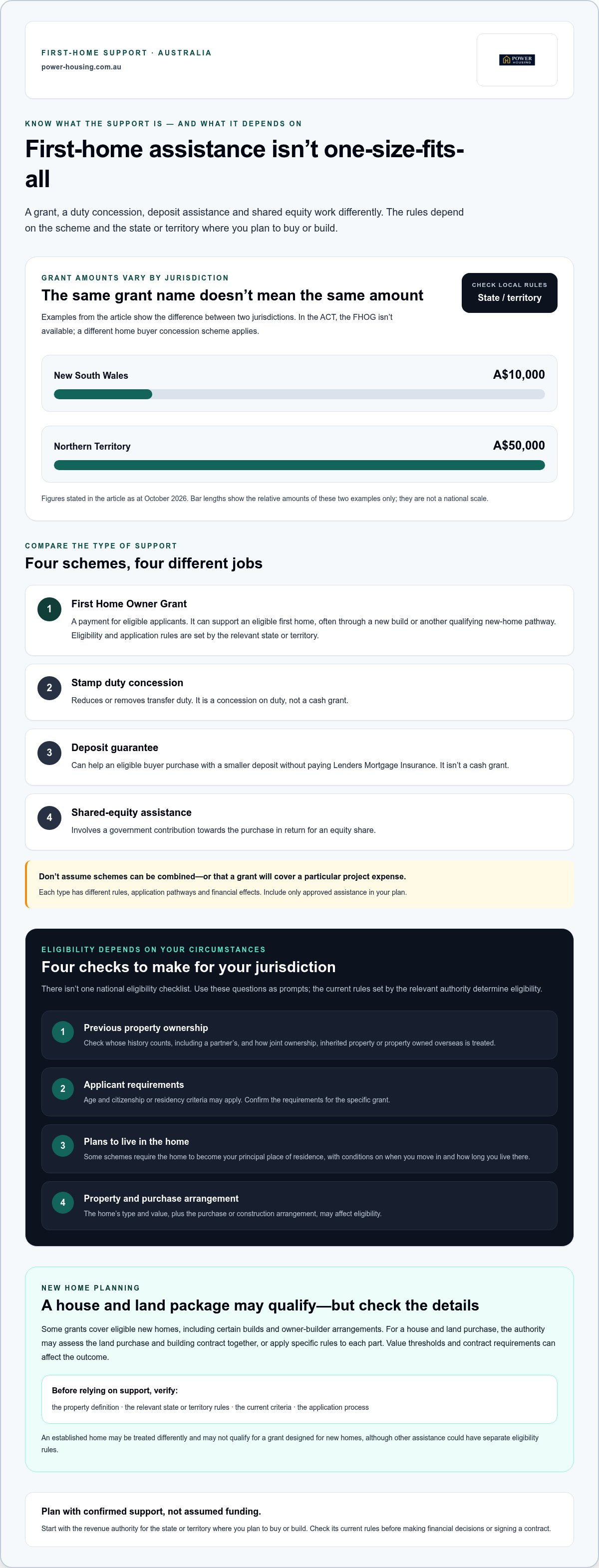
No. Each state and territory sets its own grant conditions, including eligible property types, value limits and application steps. The figures illustrate the variation: as at October 2026, the grant is A$10,000 in New South Wales and A$50,000 in the Northern Territory. In the Australian Capital Territory, the FHOG isn’t available; a different home buyer concession scheme applies.
These examples don’t replace checking the rules for your circumstances. Start with the revenue authority for the state or territory where you plan to buy or build, and confirm its current criteria before making financial decisions.
What can a first home buyer grant help with?
A first home buyers grant can provide financial assistance towards an eligible first home, often for a new build or another qualifying new-home pathway. The property definition and conditions depend on the jurisdiction. The grant isn’t automatic: you must meet the relevant criteria and have your application approved.
Keep the FHOG distinct from other forms of support. A grant is a payment for eligible applicants. A stamp duty concession reduces or removes transfer duty. A deposit guarantee can help an eligible buyer purchase with a smaller deposit without paying Lenders Mortgage Insurance, but it isn’t a cash grant. Shared-equity assistance involves a government contribution towards the purchase in return for an equity share. Each type has different rules, application pathways and financial effects.
You may be able to explore more than one type of assistance, but don’t assume schemes can be combined or that a grant will cover a particular project expense. Check each scheme’s official rules, then include only approved assistance in your new-home plan.
Who may qualify for a first home buyers grant?
There isn’t one national eligibility checklist. Before including a grant in your budget, work through these questions for the state or territory where you plan to buy or build. Definitions, thresholds and exceptions vary, and qualifying for one home-buyer scheme doesn’t automatically make you eligible for another.
- Have you or your partner owned property before? Check whose ownership history counts and which types of ownership are relevant.
- Do you meet the applicant requirements? Age and citizenship or residency criteria may apply. Confirm the rules for the specific grant.
- Will you live in the home? Some schemes require the property to become your principal place of residence, with conditions about when you move in and how long you occupy it.
- Does the property qualify? The home’s type and value, as well as the purchase or construction arrangement, may affect eligibility.
Use these questions as prompts, not universal conditions. The authority’s current rules determine eligibility. For example, Revenue NSW explains how applicants can check eligibility for the grant in New South Wales. Check the equivalent guidance for the jurisdiction relevant to your plans.
Does previous property ownership affect eligibility?
It can. The rules may define “first home buyer” differently, so don’t assume that a past interest in property automatically qualifies or disqualifies you. Check how the relevant authority treats joint ownership, an inherited property and property owned overseas. Some jurisdictions may also consider your partner’s ownership history, even if you personally haven’t owned a home.
Gather the details of any past ownership for both applicants and compare them with the 2026 criteria published by the relevant authority. If a situation is unclear, seek clarification from that authority before relying on the grant in your purchase plan.
Can a new house and land package qualify?
Potentially. Some grants cover eligible new homes, including certain builds and owner-builder arrangements. For a house and land purchase, the authority may assess the land purchase and building contract together, or apply specific rules to each part. Value thresholds and contract requirements can affect the outcome.
An established home may be treated differently and may not qualify for a grant designed for new homes, although other assistance could have separate eligibility rules. Check the property definition before committing. Once you understand the criteria, you can factor them into your build planning and explore tailored house and land package planning alongside design and construction decisions.
How do first home buyers grants differ from other Australian schemes?
First-home assistance can take several forms, and each works differently. A grant is a payment for eligible buyers; other schemes may reduce transfer duty, support a smaller deposit or help you save through super. A grant and a deposit guarantee aren’t interchangeable: one may provide financial assistance, while the other supports eligible borrowing without paying the buyer cash.
| Type of support | Purpose | Who administers it and what it may provide |
|---|---|---|
| First Home Owner Grant | Support eligible first-home purchases or builds. | The relevant state or territory government sets the rules and application process. Eligible applicants may receive a grant payment. |
| Stamp duty concession | Reduce or remove transfer duty on an eligible purchase. | State or territory authorities administer concessions under local rules. The support reduces a tax cost rather than providing cash. |
| Deposit guarantee | Help eligible buyers purchase with a smaller deposit. | The Australian Government 5% Deposit Scheme supports eligible borrowing, allowing a qualifying buyer to avoid Lenders Mortgage Insurance. It isn’t a grant or a loan repayment waiver. |
| Shared equity | Reduce the amount a buyer needs to borrow. | Under Help to Buy, the Australian Government can contribute towards the purchase price in exchange for an equity share in the home. |
What is the difference between a grant and a deposit guarantee?
A grant may provide money towards an eligible first-home purchase or build, subject to approval and the scheme’s conditions. A deposit guarantee doesn’t give you cash. Instead, the Australian Government 5% Deposit Scheme can support an eligible purchase with a deposit as low as 5% without Lenders Mortgage Insurance. You still borrow from a lender and remain responsible for repaying your home loan.
Can buyers combine a grant with other assistance?
Possibly, but don’t assume schemes can be combined. Each has separate criteria, which may cover property type and value, income, residency, occupancy and application timing. The Australian Government’s first home buyer programs include the 5% Deposit Scheme, Help to Buy and the First Home Super Saver Scheme.
Under the FHSS, eligible people can make voluntary super contributions towards a first-home deposit. The scheme allows up to A$15,000 from any one financial year to be released, up to a A$50,000 total across years. Check the current official rules for each program, including whether your planned home and state grant meet their requirements, before including assistance in your budget.
How do you check eligibility and apply for the grant?
Follow a clear sequence before including a grant in your budget. The application process depends on where the property is and whether you’re buying a completed home, purchasing land and building, or arranging an owner-builder project.
- Identify the jurisdiction. Grant rules are set by the state or territory where the home is located, not by where you currently live.
- Read the current official criteria. Check the responsible government revenue authority’s guidance for eligibility, property definitions, value thresholds and occupancy conditions.
- Match the rules to your purchase pathway. Review how the authority assesses your contract, land purchase and building arrangements. Confirm the rules before signing contracts or relying on assistance.
- Gather the required information. Use the authority’s current document checklist. Examples may include identity and residency evidence, details of past property ownership, signed contracts or building documents, and information about when you intend to live in the home. Requirements vary, and this isn’t an exhaustive list.
- Confirm where and when to apply. Depending on the jurisdiction and purchase pathway, you may apply through a participating financial institution or directly to the revenue authority. Check the relevant deadline and any approval conditions.
- Track the decision. Keep your application details and supporting records, respond to requests from the administering body, and confirm the outcome before treating the grant as available funds.
What information should buyers prepare?
Start with information that establishes who’s applying, what they’ve owned before, which property they intend to buy or build, and whether they’ll meet any residence conditions. If you’re applying with a partner, check whether their information is also required. The official checklist specifies document formats and evidence. Don’t assume a document accepted in one state or territory will meet another’s requirements.
When should you submit a grant application?
Timing can depend on the purchase pathway. Buying a completed new home may involve different evidence and milestones from buying land and arranging construction. Some applications are lodged through a financial institution, while others go directly to the relevant revenue authority. Check the current instructions for your jurisdiction before signing, and note any submission deadlines and approval conditions.
Keep your project plan grounded in confirmed funding, not an assumed grant. As you map out the land and build pathway, explore tailored house and land planning as part of your new-home decisions.
How can grant research support a confident new-home plan?
Use grant research as one input in your planning, rather than the starting point for every decision. The first home buyers grant may influence how you compare options, but eligibility depends on the applicable rules and your circumstances. Build your plan around a home and land that suit your needs, then check how the purchase and construction arrangements fit the grant criteria.
What should you consider before choosing a house and land package?
Consider the land, proposed home design and intended use together. Think about how the layout will work for your household, what matters most in the home and whether the land suits your plans. Then check how the jurisdiction assesses the arrangement. Buying land and building may be treated differently from purchasing a completed new home, and conditions can apply to contracts, property values and occupancy.
Make a project budget that accounts for the full plan, including land, construction and other costs relevant to your circumstances. Don’t rely on a grant as guaranteed funding or assume it can be used for a particular expense. Treat any assistance as a possible benefit only after checking the official rules and confirming the application outcome.
How can design planning fit into your next steps?
Once you’ve identified the eligibility questions, include them in your design planning. Custom home design assistance can help shape a home around your priorities while you consider how the proposed build aligns with the grant’s property and construction requirements. It won’t determine grant approval, but early planning can help you make more informed decisions about the home, land and build pathway.
Power Housing coordinates tailored house and land packages and provides custom home design assistance for new residential builds. This can be a practical part of turning your research into a considered project plan.
- Identify the state or territory rules that apply to the property.
- Check how the scheme treats your ownership history and purchase or build arrangement.
- Review the current application steps and approval conditions.
- Budget for the full project without counting on unapproved assistance.
With those checks in hand, you can plan your next move with greater clarity. Explore tailored house and land packages and consider how custom design assistance could support your new-home plans.
Plan your first-home purchase with confidence
The first home buyers grant can support an eligible purchase or build, but the rules depend on the state or territory and the details of your home. Check your ownership history, residence plans and property pathway against current official guidance before signing contracts or counting on assistance.
Keep the grant distinct from other support, such as stamp duty concessions, deposit guarantees and shared equity. These work differently, and eligibility for one doesn’t guarantee access to another. Build your budget around the full land and construction plan, treating any grant as possible assistance rather than guaranteed funding.
Once you’ve completed your eligibility research, bring it into your new-home planning. Power Housing coordinates tailored house and land packages and provides custom home design assistance for residential builds. Explore tailored house and land packages as you shape a plan that reflects your needs and goals.
With clear information and a considered pathway, you can take your next step towards a home of your own with greater confidence.
Frequently Asked Questions
Is the First Home Owner Grant available in every Australian state and territory?
No. The First Home Owner Grant isn’t available in the same form in every jurisdiction. Each state and territory sets its own rules, and the Australian Capital Territory has replaced its grant with the Home Buyer Concession Scheme. Check the current guidance from the revenue authority where the property is located. Grant names, amounts, eligible homes and application processes can change, so don’t rely on rules from another state or territory.
Can I get a first home buyers grant for an established home?
Usually, the First Home Owner Grant is aimed at eligible new or substantially renovated homes rather than established homes. The exact definition and any exceptions depend on the state or territory. An established property may still qualify for a separate form of assistance, such as a stamp duty concession, but that isn’t the same as receiving a grant. Check the current rules for the property and scheme you’re considering.
Can a house and land package qualify for the First Home Owner Grant?
Yes, a house and land package may qualify if it meets the relevant grant rules. Authorities can assess the land purchase and building contract together, and criteria may cover the combined value, contract arrangements and whether the home is new. Requirements differ by jurisdiction and build pathway. Before signing, check how the relevant revenue authority treats your arrangement, including any construction deadlines or occupancy conditions.
Does my partner’s previous property ownership affect my eligibility?
It may. Some jurisdictions consider an applicant’s partner or co-applicant when assessing first-home status, while the rules and definitions vary. Check how the authority treats previous joint ownership, inherited property or property owned overseas, and whether your partner’s history is relevant to your application. Don’t assume you qualify based only on your own ownership record. Review the current eligibility guidance for your state or territory before relying on a grant.
How do I apply for the First Home Owner Grant?
Start with the revenue authority for the state or territory where the home is located. Its current guidance explains eligibility, required evidence, deadlines and the application channel. Depending on the jurisdiction and whether you’re buying or building, you may apply through a participating financial institution or directly to the revenue authority. Prepare identity, ownership-history, contract and residence information as requested, then wait for the decision before treating the grant as approved.
Can I combine the grant with the First Home Guarantee or other assistance?
You may be able to access more than one scheme, depending on each program’s rules and your circumstances. The First Home Guarantee is now called the Australian Government 5% Deposit Scheme. Its criteria are separate from state and territory grant or stamp duty rules. Property type, income, residency and application conditions can differ, so confirm current requirements with each scheme administrator before including multiple forms of assistance in your budget.
Do I have to live in the home after receiving a first home buyers grant?
Often, grant eligibility includes a requirement to occupy the home as your principal place of residence, but details differ across Australia. The rules may specify when you need to move in and how long you must live there. Check the current conditions for your jurisdiction and purchase pathway before applying. If your plans change after approval, contact the administering authority to understand how that could affect your grant.


