

A builder’s name on a polished quote isn’t proof they’re licensed or insured for your project. If you’re wondering how to check a builder's license and insurance, start by matching the legal entity in the paperwork with the details on the official register. A company name, salesperson or trading name may not be the licensed builder you need to verify.
Licensing systems and insurance requirements differ across Australia. A current licence alone doesn’t confirm that the right cover applies to your project, so resolve any mismatch in names, scope or dates before you sign a contract or pay a deposit.
This checklist explains which state or territory register to use, what to confirm about the builder’s licence and which insurance documents to request. It also shows how to check that evidence is current and relevant to the correct business and project, and what to do if details don’t line up. Use these checks as part of comparing a new-home project.
Key Takeaways
- Use the official register for the state or territory where the work will take place to check a builder's license and insurance requirements.
- Match the registered legal entity and licence details against the builder named in your draft quote and contract.
- Request current insurance evidence and check that it relates to the correct business and project.
- Pause before signing or paying if details don’t match, evidence is missing or the builder pressures you to proceed.
- Include independent builder checks when comparing a new-home project, alongside land suitability, design fit and package inclusions.
Why check a builder’s licence and insurance before committing?
Before signing a building contract or paying a deposit, confirm that the right builder is authorised to carry out the proposed work and that relevant insurance arrangements are in place. These are separate checks. A licence relates to permission to perform specified work under the rules of the state or territory. Insurance relates to particular risks or obligations, and doesn’t prove that the builder holds the required licence.
Licence status, permitted work and insurance are separate checks. Requirements vary by jurisdiction, so don’t assume a check or document used for one project automatically applies to another. Check the local rules and confirm the details for your specific project.
What does a builder’s licence actually confirm?
An official register may show whether a licence or registration is current, who holds it, what work it covers and whether conditions or restrictions apply. The information available differs between jurisdictions. Compare the result with the work described in your proposed contract, rather than relying on a general claim that someone is “licensed”.
Check the legal entity named in the contract as well as any individual builder’s credentials. An individual’s registration and a company’s identity aren’t necessarily interchangeable. A licence is a useful regulatory check, but it doesn’t guarantee workmanship, financial stability or a trouble-free build.
Australia also has a national technical framework. The Australian Building Codes Board is responsible for the National Construction Code. That framework is distinct from state and territory licensing, so use the relevant local register to check the builder’s authorisation and permitted work.
Why insurance needs its own verification
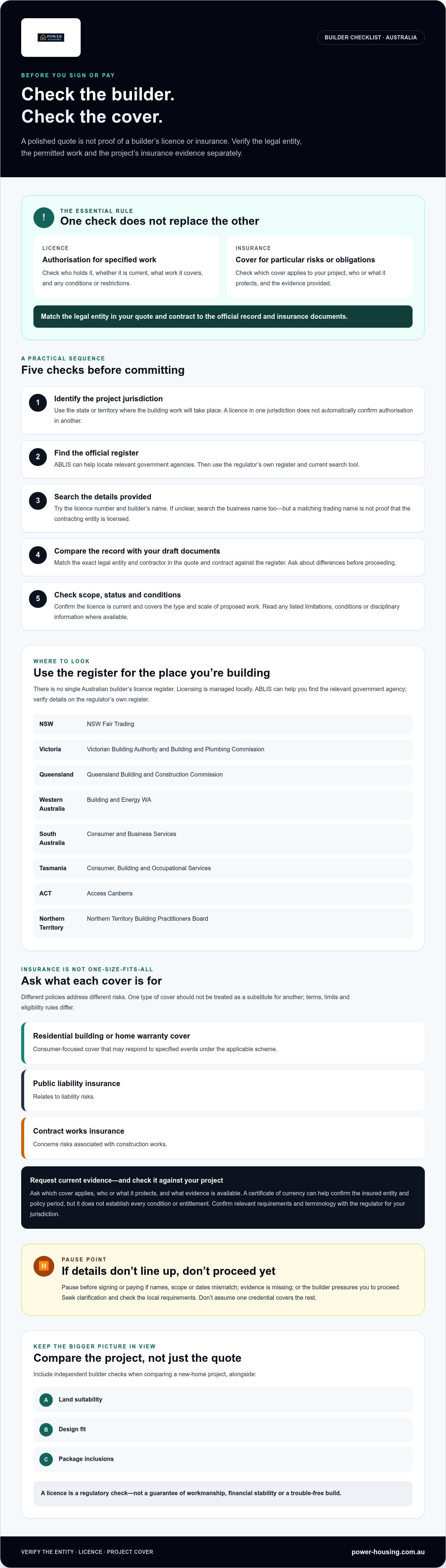
Different insurance policies address different risks, and one shouldn’t be treated as a substitute for another. Residential building or home warranty cover is consumer-focused and may respond to specified events under the applicable scheme. Public liability insurance relates to liability risks, while contract works insurance concerns risks associated with construction works. Each has its own terms, limits and eligibility rules.
Ask the builder which cover applies to your project, who or what it protects, and what evidence is available. A certificate of currency can help confirm details such as the insured entity and policy period, but it doesn’t establish every condition or entitlement. Check the document against the contract, then confirm relevant requirements and terminology with the regulator for the project’s jurisdiction.
If the licence record, contract name or insurance document doesn’t line up, pause and seek clarification. Don’t assume one credential covers the rest.
How to check a builder’s licence in your state or territory
There’s no single Australian builder’s licence register. Licensing is managed locally, and the right register depends on where the building work will take place. Use this process to check the relevant record and compare it with your contract documents.
- Identify the jurisdiction. Confirm which state or territory the project is in. A builder’s licence in one jurisdiction doesn’t automatically confirm they’re authorised to do the work in another.
- Find the official register. Start with the Australian Business Licence and Information Service (ABLIS) to locate relevant government agencies, then use the regulator’s own register. For example, NSW Fair Trading provides a NSW builder licence check. Other regulators include the Victorian Building Authority and Building and Plumbing Commission, Queensland Building and Construction Commission, Building and Energy WA, Consumer and Business Services in South Australia, Consumer, Building and Occupational Services in Tasmania, Access Canberra and the Northern Territory Building Practitioners Board. Check the regulator’s current website for the correct search tool.
- Search using the details provided. Try the licence number and the builder’s name. If the result is unclear, search the business name too, but don’t treat a matching trading name as proof that the contracting entity is licensed.
- Compare the result with your draft documents. Check the exact legal entity and contractor named in the quote and contract against the register. Confirm that the licence number and business details match, and ask about any difference before proceeding.
- Review what the record says. Check that the licence is current and covers the type and scale of work proposed. Read any listed conditions, limitations or disciplinary information where the register provides it. If you can’t tell whether a condition affects your project, ask the regulator to explain the record.
Verify the contracting entity and scope, not just a familiar trading name. An individual’s credentials may not establish that the company signing your contract holds the appropriate authorisation. Start with the correct entity and the specific work, rather than relying on a quick name search.
Keep a copy of the register result and note when you checked it. If you’re comparing a new-home project, you can also review tailored house and land packages while independently verifying the proposed builder and contract details.
How to verify a builder's insurance and request evidence
Insurance checks are separate from licence checks. A current licence doesn’t show whether the right insurance applies to your project. The names, thresholds and eligibility rules for residential building cover vary across Australia, so confirm current requirements with the regulator in the project’s state or territory.
Which insurance types might matter for a new home build?
Residential building insurance, also called home warranty or indemnity cover in some jurisdictions, is consumer-focused cover governed by local scheme rules. For example, NSW calls its scheme Home Building Compensation cover, while Queensland uses the Queensland Home Warranty Scheme. Public liability and contract works insurance are different policy types. They may address liability risks and risks to construction works respectively, but neither should be assumed to replace required consumer cover.
Use the comparison below as a starting point, not a substitute for checking the rules that apply to your project.
| Cover type | What it may address | Evidence to request | Verification source |
|---|---|---|---|
| Residential building or home warranty cover | Specified consumer protections under the relevant jurisdiction’s scheme. | Required certificate or other scheme evidence showing the builder, project and cover details. | State or territory regulator or scheme check tool. In NSW, ask about HBC cover and the HBC Check tool. |
| Public liability | Liability risks arising from the builder’s activities, subject to policy terms. | A current certificate of currency naming the insured business. | Request it from the builder, then contact the insurer if details need confirmation. It isn’t publicly searchable. |
| Contract works | Risks affecting construction works, subject to the policy’s terms and exclusions. | Policy schedule or other evidence showing insured parties, project details and dates. | Ask the builder or insurer to confirm the policy’s relevance to the project. |
| Workers’ compensation | Work-related injury obligations where the builder has employees. | Current certificate of currency, where applicable. | Check with the relevant state or territory authority. NSW icare provides a lookup tool. |
Check the certificate, policy details and project connection
Request evidence tied to the builder, project and applicable cover period. Check the insured legal entity against the contract, confirm the insurer and policy dates, and look for project details where the cover requires them. Ask whether the document is a certificate of currency, policy schedule or another form accepted by the relevant scheme.
A certificate summarises information, but may not explain every exclusion or condition. If authenticity, scope or eligibility is unclear, contact the insurer or regulator independently before relying on it. In NSW, the Check a builder or tradesperson licence tool confirms licence details, not insurance. Check any required HBC cover separately.
What to do if checks reveal gaps, mismatches or warnings
A discrepancy doesn’t automatically mean a builder has done something wrong. It does mean you need a clear explanation and independent confirmation before committing. Pause before signing the contract or paying a deposit if you find warning signs such as:
- A licence appears expired, restricted or unrelated to the work described.
- The name or licence number on the register differs from the quote, contract or insurance evidence.
- Insurance documents are missing, out of date or unclear about the insured business or project.
- The builder’s explanation doesn’t resolve the difference, or you’re pressured to proceed before checks are complete.
Resolve discrepancies before signing or paying
Ask the builder to explain the specific difference between the register, quotation, insurance documents and contract. Keep your questions factual. For example, ask why the contract names a different legal entity or request clarification about a licence condition that may affect the proposed work.
Request corrected documents where needed, then independently confirm material changes with the relevant regulator or insurer. Don’t rely only on a verbal assurance. A mismatch could have a straightforward explanation, such as a business-name change, but verify it before moving forward.
Keep a record of your checks. Save register results, note the date of each search, retain copies of documents and record the questions you asked and the responses received. This gives you a useful reference if details change or questions arise later.
Use a final pre-contract verification checklist
Before signing or paying, work through these checks:
- Entity: The legal entity named in the contract matches the builder or business details confirmed on the register.
- Licence: The status is current, the permitted work fits the proposed project, and you understand any listed conditions or limitations.
- Insurance: You’ve obtained the evidence required for the relevant jurisdiction and confirmed the insured entity, policy details and connection to your project.
- Contract: The contracting entity matches your verified records, and any unresolved terms or discrepancies have been addressed in writing.
If the register or policy wording is difficult to interpret, ask the relevant regulator or insurer for clarification. For contract terms or a dispute you can’t resolve, seek independent legal or consumer advice. A builder can explain their documents, but that explanation isn’t independent advice.
Once the checks are clear, you can make a more informed decision about your new-home plans. Explore tailored house and land packages as you compare land and design choices, while keeping builder and insurance verification as a separate step.
Make builder checks part of choosing your new-home project
A suitable builder is one part of a well-matched new-home project. Consider licence and insurance checks alongside land suitability, design requirements and package inclusions. This lets you compare the full proposal rather than relying on a familiar name or appealing design alone.
Compare the whole project, not credentials alone
As you shortlist options, keep a clear record of what each project involves. Consider whether the land suits your needs, whether the proposed design fits your household and whether the written inclusions align with your expectations. Then verify the builder independently and resolve any gaps before you commit.
A practical sequence is:
- Shortlist projects that align with your land, design and home requirements.
- Verify the proposed builder’s licence and relevant insurance using official sources.
- Resolve mismatches or unanswered questions with the builder and, where needed, the regulator or insurer.
- Review the final contract to confirm the named entity, scope of work and documented inclusions.
Use a guide to what to look for in a house and land package to assess the broader offer, and follow a step-by-step guide to building a new home in Australia to understand how project decisions fit together. These resources can complement your due diligence, but they don’t replace checking the builder and contract yourself.
Get guidance while keeping verification independent
Power Housing coordinates tailored house and land packages and assists with custom home design. This can help organise decisions about land and design as you compare potential projects. Builder licensing and insurance checks remain separate: confirm these directly through the relevant official sources. Package coordination or design assistance doesn’t confirm a builder’s credentials or performance.
If a project looks promising, continue through the checks at your own pace. Make sure important details are clear, documented and consistent before signing or paying. For support comparing land and home design choices, explore tailored house and land package guidance.
Take your next building step with confidence
A sound decision starts with independent checks. Use the official register for the project’s state or territory, match the licensed entity and permitted work to your draft contract, and verify that insurance evidence is current and relevant to your project. If names, conditions or documents don’t line up, pause and get clarification before signing or paying.
Knowing how to check a builder's license and insurance helps you assess one important part of a new-home project. Consider it alongside the land, design requirements and written package inclusions. Power Housing coordinates tailored house and land packages and assists with custom home design. Builder licensing and insurance should be verified independently through the appropriate sources.
Explore tailored house and land package guidance as you compare your options. Clear checks and considered project choices can help you move forward with greater confidence.
Frequently Asked Questions
How do I check if a builder is licensed in Australia?
Search the official building regulator’s register for the state or territory where the work will take place. Use the builder’s licence number and legal name, then compare the result with the entity named in your proposed contract. Check the current status, permitted work and any listed conditions. If the register is unclear, contact the regulator before signing or paying.
Can I check a builder’s licence online?
Many jurisdictions provide an online regulator register or search tool, though the information shown varies. Use a government source rather than relying only on a builder’s website, directory listing or screenshot. Check that the result matches the legal entity in your documents. If details are missing or inconsistent, contact the regulator directly and ask how to verify the record before proceeding.
What insurance should a builder have in Australia?
There isn’t one insurance requirement that applies to every Australian project. Residential building insurance, sometimes called home warranty or indemnity cover, has jurisdiction-specific names and eligibility rules. Public liability and contract works insurance address different risks and shouldn’t be assumed to replace required consumer cover. Ask which cover applies to your project, request current evidence and confirm the requirements with the relevant state or territory regulator.
How can I verify a builder’s insurance certificate?
Check the insured legal entity, insurer, policy dates and any project details shown on the document. Then confirm that the evidence is appropriate for the work and jurisdiction. A certificate alone may not explain all policy terms or establish that the cover meets scheme requirements. If the document looks inconsistent or its scope is unclear, contact the insurer or regulator independently and ask what evidence is accepted.
What happens if a builder’s licence has expired?
Pause before signing or paying, and confirm the register information directly with the regulator. Don’t assume the expiry is a minor administrative delay or that the builder can still perform the proposed work. Ask the builder for an explanation, then check with the regulator whether the licence has been renewed or whether restrictions apply. Consider independent legal or consumer advice before deciding how to proceed.
Does a builder’s licence guarantee good workmanship?
No. A licence confirms authorisation for specified work under the applicable rules, but it doesn’t guarantee workmanship, financial stability or a trouble-free project. Check the licence and relevant insurance separately, then review the proposed contract, specifications and any complaint information available from official sources. If important details remain unclear, seek independent advice before committing. These checks help you make a more informed choice, not predict every project outcome.
Should the builder’s company name match the licence?
Any difference in names should be explained and verified before you commit. A builder may use a trading name while the register or contract shows a legal entity, so a mismatch doesn’t automatically indicate a problem. Ask for the relationship between the names in writing and confirm it with the regulator. Also check that the contracting entity and insurance evidence relate to the work you’re considering.


