

The biggest risk in a building contract may be what it leaves unclear, not the headline price. If you’re searching for questions to ask builder before signing contract, focus on the details that shape the work, cost and accountability. A clear quote is a starting point, but the written scope, allowances and contract terms show what you’re committing to.
It’s sensible to want certainty before you sign. Inclusions and exclusions can be easy to overlook, while variations, delays and dispute processes may be difficult to assess until a problem arises. Asking direct questions now can help you spot gaps, request written clarification and decide whether to seek independent advice before proceeding.
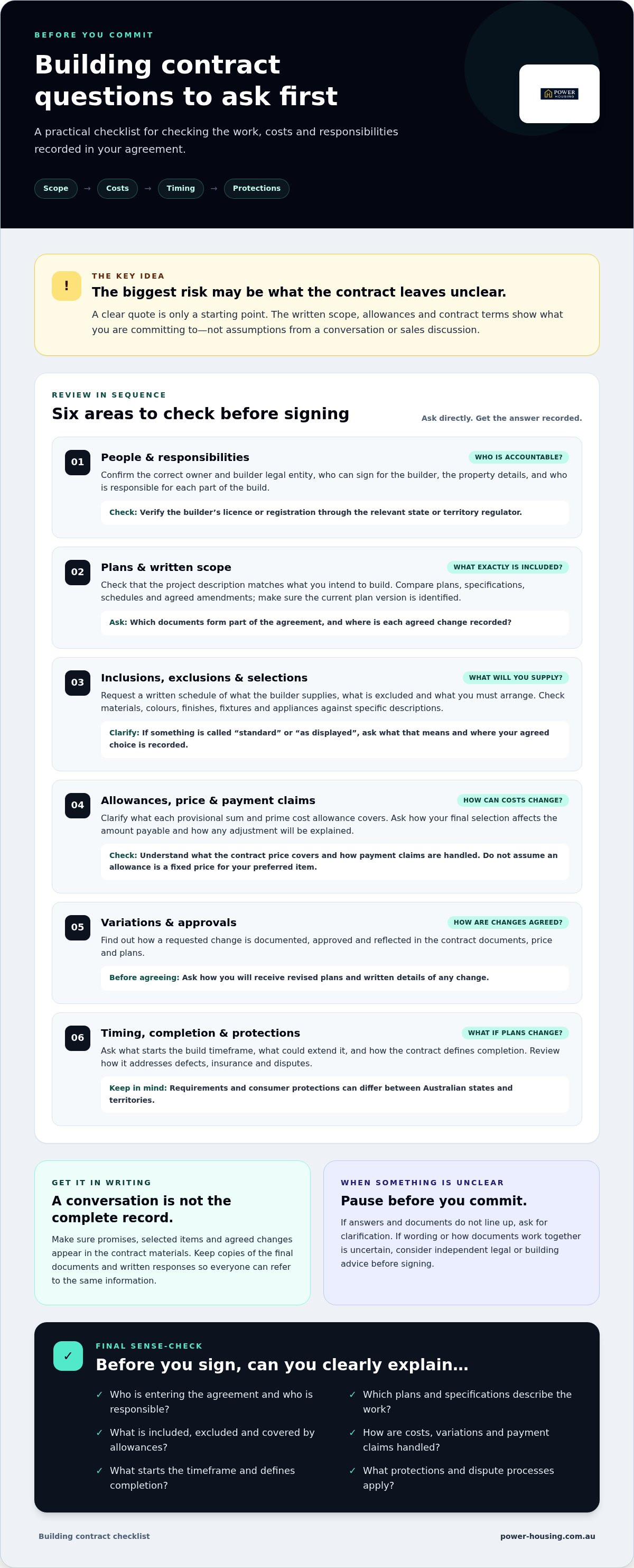
This practical 2026 checklist covers the key areas to examine: project scope, materials and allowances, contract price and payment stages, variation approval, timing, and protections if things don’t go to plan. Use it to identify what to ask and what to have confirmed in writing before making a commitment.
Key Takeaways
- Check the legal names of the parties and who is responsible for each part of the build before you commit.
- Compare the plans, specifications and schedules, then flag any inclusion or exclusion that isn’t clearly recorded.
- Use these questions to ask builder before signing contract to clarify how allowances, price changes and payment claims will be handled.
- Find out what starts the build timeframe, what could extend it and how the contract defines completion.
- Pause if answers or documents don’t line up, and consider independent advice before signing.
Before you sign a building contract, confirm who is responsible for what
Signing commits you to the terms written in the contract, not to assumptions based on a conversation, sales discussion or earlier email. Before you sign, identify who is taking on each obligation and where it’s recorded. A Construction contract sets out the parties’ agreed work and terms, so read it alongside every document it refers to.
Start with the essentials: confirm the scope of work, what the price covers, how timing is described, how changes must be approved and how the contract handles disputes. These questions to ask builder before signing contract can help you identify gaps before they become difficult to resolve. Requirements and consumer protections can differ between Australian states and territories, so check the rules that apply where your project is located rather than relying on general advice.
Who exactly is signing the building contract?
Check that the contract names the correct owner and the builder’s legal entity, not just a trading name. Ask who is authorised to sign for the builder, and verify the builder’s licence or registration using the relevant state or territory regulator’s official information. Confirm the property details, including the land the work relates to, and make sure the project description matches what you intend to build.
If a company or more than one owner is involved, check that the names and signing arrangements are accurate. Raise any mismatch before signing. A clear record of the parties helps everyone understand who has agreed to do the work and who is entering the contract.
What should be settled before signing?
Ask which documents form part of the agreement. Request a complete set and check that the referenced plans, specifications, schedules and agreed amendments are attached or clearly identified. For example, if a revised plan shows a different layout, make sure the contract documents refer to that version rather than an earlier drawing.
Compare the documents with what you’ve discussed. Confirm that each verbal promise or agreed change has been written into the contract materials. If something is missing, ask for it to be added or clarified before you sign. Keep copies of the final documents and written responses, so you can refer to the same agreed information throughout the process.
Don’t guess at wording that affects your obligations. If a clause is unclear, or you’re unsure how the documents work together, seek independent legal or building advice before committing. Checking the foundations of the agreement gives you a clearer basis for reviewing the plans, costs and protections that follow.
Questions to ask your builder about plans, inclusions and specifications
Make sure the plans, specifications and schedules describe the same home before you sign. A detail shown on a drawing but missing from the written specification can leave room for different interpretations. Compare the documents side by side, and ask the builder to resolve anything that doesn’t match.
Among the most useful questions to ask builder before signing contract are: “Which version of the plans forms part of the contract?” and “Where are the agreed materials, finishes and fixtures specified?” Get answers in writing. A showroom display or conversation may help you choose, but it shouldn’t be the only record of what the project includes.
Do the plans match the home you agreed to build?
Check the layout, dimensions, elevations and site-specific drawings against your agreed design. Look closely at room sizes, window and door locations, and features that matter to how you’ll use the home. Ask how the drawings account for the land’s levels, site conditions and access, and whether those factors affect the documented scope.
Confirm the plan revision or date that will be attached to the contract. If you request a change later, ask how it will be documented and approved, and how you’ll receive the revised plans. This helps prevent an earlier drawing from being mistaken for the final agreed version.
Which inclusions, exclusions and allowances need clarification?
Ask for a written schedule showing what the builder will supply, what’s excluded and what you’re expected to arrange yourself. Check materials, colours, finishes, fixtures and appliances against specific descriptions. If a selection is described only as “standard” or “as displayed”, ask what that means in practice and where the agreed choice is recorded.
Clarify any provisional sums and prime cost allowances. Ask what each allowance covers, how your final selection affects the amount payable, and how any adjustment will be explained. Don’t assume an allowance is a fixed price for your preferred item.
Check items that can sit outside the main home scope, such as landscaping, service connections and driveways. Ask whether each is included, excluded or supplied by you, and where that’s stated. Record the answer and request updated contract documents if anything changes.
- Plans: Do all documents show the same layout and revision?
- Selections: Are the agreed products and finishes described clearly?
- Scope: Is each item included, excluded, allowed for or owner-supplied?
For buyers still aligning land requirements with a home design, exploring tailored house and land options can help clarify project requirements before contract decisions. Keep contract review separate, and seek independent advice if any wording remains unclear.
How will the building contract handle price, variations and payment claims?
Don’t treat the contract price as the full picture until you understand what it covers. Separate the stated price from allowances, exclusions and costs that depend on later selections or decisions. Then check which events may change the amount payable and what process the builder must follow to notify you.
If you’re compiling questions to ask builder before signing contract, focus on the triggers and paperwork, not just the starting figure. The answers should be clear in the signed documents. Avoid relying on a verbal assurance that a change “won’t cost much” or that an allowance will cover your preferred selection.
What can change the contract price after signing?
Ask how provisional sums and prime cost items are reconciled once work is completed or you’ve made a selection. Find out what information you’ll receive to explain any adjustment, and how the contract treats owner-requested changes, unexpected site conditions or other circumstances that could affect the price.
Before approving a variation, ask what must be documented: the changed work, the price adjustment, any supporting details and the effect on the build timeframe. Check whether the contract requires your written approval before the change proceeds, and follow the process it sets out. Keep a copy of each request, response and approved amendment.
- What circumstances allow the price to change?
- How will the builder explain and support an adjustment?
- How could the change affect timing or other contract terms?
A clear process helps you understand a proposed change before authorising extra work. If the contract wording doesn’t explain how adjustments are calculated or approved, ask for clarification before signing.
When are progress payments due and what supports each claim?
Review every payment stage. Ask what completed work triggers each claim and how you can verify that the stage has been reached. The schedule should make the milestone and amount due understandable, rather than relying on broad labels that leave you unsure what has actually been completed.
Check how claims, invoices or notices must be issued, what supporting information they need to include and when payment is due under the contract. Confirm who receives the documents and how you should raise a query if a claim doesn’t appear to match the stated stage. Don’t assume the same payment process applies to every building contract.
Keep the contract, payment schedule and any written explanations together so you can check a claim against the agreed terms. If payment wording, a price adjustment or your financial obligations remain unclear, seek independent legal or financial advice before accepting the schedule. Focus on the specific contract terms and your own circumstances rather than relying on general price estimates.
What to ask about build timing, defects, insurance and disputes
A stated construction timeframe is only useful if you know when it starts and what can extend it. Ask how the contract sets the commencement date, estimated duration and process for notifying you about delays. Check what notice the builder must give, what details it must include and how a proposed extension is assessed. The contract should explain the process, not leave you guessing.
How are delays, completion and handover defined?
Ask what needs to happen before construction is considered to have started, and which events may affect the timeframe. Then check how the contract defines practical completion. Does it mean all agreed work is finished, or can specified items remain outstanding? Ask how incomplete work is recorded and what steps follow.
Clarify the handover process, including inspections, keys and the documents you should receive. Check what the contract says about final payment and occupation, and whether these steps depend on particular requirements being met. Keep the process in writing so you understand what to expect as the build approaches completion.
What happens if defects or disagreements arise?
Ask how to record and report defects, who to notify, and what process applies after an inspection or handover. Locate the clauses covering complaints, dispute escalation and termination. Make sure you understand how to raise a concern, what response process the contract describes and what options are available if the issue isn’t resolved. Seek independent advice if the wording is unclear.
Review the insurance, warranty and statutory references in the contract, but don’t assume one state’s requirements apply across Australia. Ask which requirements relate to your project and confirm them with the relevant state or territory regulator or an independent adviser. If the contract cites a law, policy or warranty, check that the reference is current and applies to your circumstances.
- Timing: What starts the build period, and how are delays notified?
- Completion: What does practical completion mean, and how are outstanding items handled?
- Protections: How are defects, complaints and disputes managed?
- Coverage: Which insurance and warranty terms apply to this project and jurisdiction?
These are important questions to ask builder before signing contract because delay, defect and dispute clauses shape what happens when the project doesn’t follow the expected path. If key terms remain uncertain, pause and get independent advice before committing. Once you’ve completed your due diligence, you can explore tailored house and land options as a separate step towards planning a new build.
Use this final building contract checklist before you decide to sign
Take one last pass through the agreement before committing. This sign-or-pause review brings the key questions to ask builder before signing contract into a practical check. Mark each point only when the answer is clear, documented and consistent across the contract documents.
Run a final five-point contract check
- Confirm the parties and property. Check the owner and builder’s legal names, signing authority, land details and project description. Pause if any details are incorrect or incomplete.
- Match the plans and scope. Confirm the contract refers to the correct plan versions, specifications and schedules. Check that inclusions, exclusions and owner-supplied items are clearly identified.
- Understand the price. Reconcile the contract price with allowances, exclusions and payment stages. Make sure you understand how provisional sums, selections and other adjustments are handled.
- Check the change process. Confirm how variations must be described, priced, approved and recorded, including any effect on timing. Keep a copy of each approved amendment with the contract documents.
- Review timing and protections. Check the construction timeframe, delay notices, completion and handover terms, defect process, insurance references and dispute procedures.
For every item, ask yourself: do I have the answer in writing, do the relevant documents match, and do I understand what I’m agreeing to? Keep written responses and the final versions of plans, schedules and amendments together. A verbal explanation can clarify a point, but it shouldn’t replace an agreed change in the contract documents.
Pause before signing if key terms are missing, documents conflict or an obligation isn’t clear to you. Ask the builder to resolve inconsistencies in writing. For advice about the specific contract or your obligations, consider an independent legal or building review. Requirements can differ across Australian states and territories, so check jurisdiction-specific questions with an appropriate adviser.
Choose a supported path to your new home
Contract due diligence and planning your home are separate steps. Once you’ve addressed the contract questions, aligning land requirements with your preferred design can help clarify what you want from a new build. Power Housing coordinates tailored house and land packages and assists with custom home design. It isn’t the builder or a provider of legal advice.
Explore tailored house and land options with Power Housing.
Move forward with clarity before you sign
A building contract deserves a careful final check. Confirm the named parties and project details, make sure plans and specifications match what you’ve agreed, and understand how allowances, variations and payment claims may affect your commitments. Check the timing, completion, defects and dispute processes too. If any term is unclear or inconsistent, pause and seek independent advice before signing.
Use these questions to ask builder before signing contract to turn assumptions into written answers. Keep the final contract documents and approved amendments together, so you have a clear record of what’s been agreed.
Once your contract due diligence is complete, you can continue planning your new home. Power Housing coordinates tailored house and land packages nationally and provides custom home design assistance. Explore tailored house and land options with Power Housing.
Take it one step at a time. Clear information helps you make your next decision with greater confidence.
Frequently Asked Questions
What should I check before signing a building contract in Australia?
Check the parties, land details, plans, specifications, inclusions, exclusions, price, allowances, payment stages and variation process. Also review the construction timeframe, delay notices, completion and handover terms, defect process, insurance references and dispute clauses. Make sure referenced documents are attached or clearly identified, and that agreed changes are recorded in writing. Contract requirements and protections differ across states and territories, so confirm what applies to your project.
Can I negotiate a building contract before I sign it?
Yes, you can raise questions and request changes before signing. Ask the builder to clarify any unclear term and record agreed amendments in the contract documents, rather than relying on a conversation or informal message. Check that revised plans, specifications or schedules match the updated terms. The builder may not agree to every request, so don’t assume a change has been accepted until it’s confirmed in writing by the relevant parties.
What happens if a builder changes the contract price after signing?
Check the contract’s price-adjustment and variation clauses before responding to a proposed increase. Ask the builder to identify the reason, explain the calculation and provide supporting details in writing, including any effect on timing. The contract and applicable state or territory rules determine the process. Don’t assume a price change is valid or invalid without reviewing the circumstances. If you dispute the adjustment or the terms are unclear, seek independent legal advice promptly.
Are provisional sums and prime cost allowances included in the contract price?
They may be included as estimated amounts in the contract price, but they aren’t necessarily final costs. A prime cost allowance commonly relates to an item you’ll select later, while a provisional sum allows for work whose cost isn’t settled when the contract is prepared. Check exactly what each allowance covers, how the actual amount is reconciled and whether adjustments or other charges may apply. Ask for the process in writing before signing.
Should I get a solicitor to review a building contract before signing?
Independent legal advice can help you understand the contract’s obligations, risks and state-specific requirements before you commit. It’s particularly useful if clauses about price changes, delays, termination or disputes are unclear, or if documents appear inconsistent. A solicitor can review your specific agreement; a general checklist can’t replace that advice. You may also consider independent building advice to help assess the technical scope, plans and specifications.
What should be included in a new home building contract?
A new home building contract should clearly identify the parties, property and agreed work, with the relevant plans, specifications and schedules attached or referenced. Check for the contract price, allowances, exclusions, payment stages and variation procedure. The agreement should also explain timing, delay notices, completion, handover, defect processes and how disputes are handled. Confirm which insurance and warranty terms apply to your project, and verify jurisdiction-specific requirements with an appropriate adviser.
Can I cancel a building contract after signing in Australia?
Possibly, but your options depend on the contract, the circumstances and the state or territory where the project is located. Don’t assume you can cancel without consequences or that a cooling-off period applies to your particular agreement. Read the cancellation, termination and dispute clauses, then promptly seek independent legal advice about your position and any required notice. Keep copies of the contract and all communications, and avoid relying on a verbal assurance about cancellation.


