
The more customised build isn’t automatically the better choice. The project home vs custom build pros and cons come down to what you need from the design, your block and the building process, not simply how much choice sounds appealing.
A project home may give you a more defined starting point, while a custom build can offer greater scope to shape the layout around your lifestyle and land. The practical differences depend on the plans, contract and design process. Upgrades, variations and the number of decisions involved can also affect how each pathway fits your budget and expectations.
If you’re weighing up both options, compare them against your priorities before committing. This guide explains the trade-offs and shows how to assess your budget, block and preferred level of involvement. You’ll also learn what to review in the project scope and how a tailored house and land package or custom home design assistance can help align a new home with your requirements.
Key Takeaways
- Use the project home vs custom build pros and cons to compare design choice, site fit, decision effort and budget planning against your priorities.
- Look beyond an advertised or quoted figure. Compare the proposed scope and understand how selections or changes could affect the project.
- Assess your block before settling on a design pathway, because its characteristics can influence how well a plan suits your household.
- Rank your priorities, compare the written scope, then consider how much time and input you want to give the design process.
- Explore how coordinating land selection with home design can help align a tailored house and land package with your requirements.
Project home vs custom build: what is the difference?
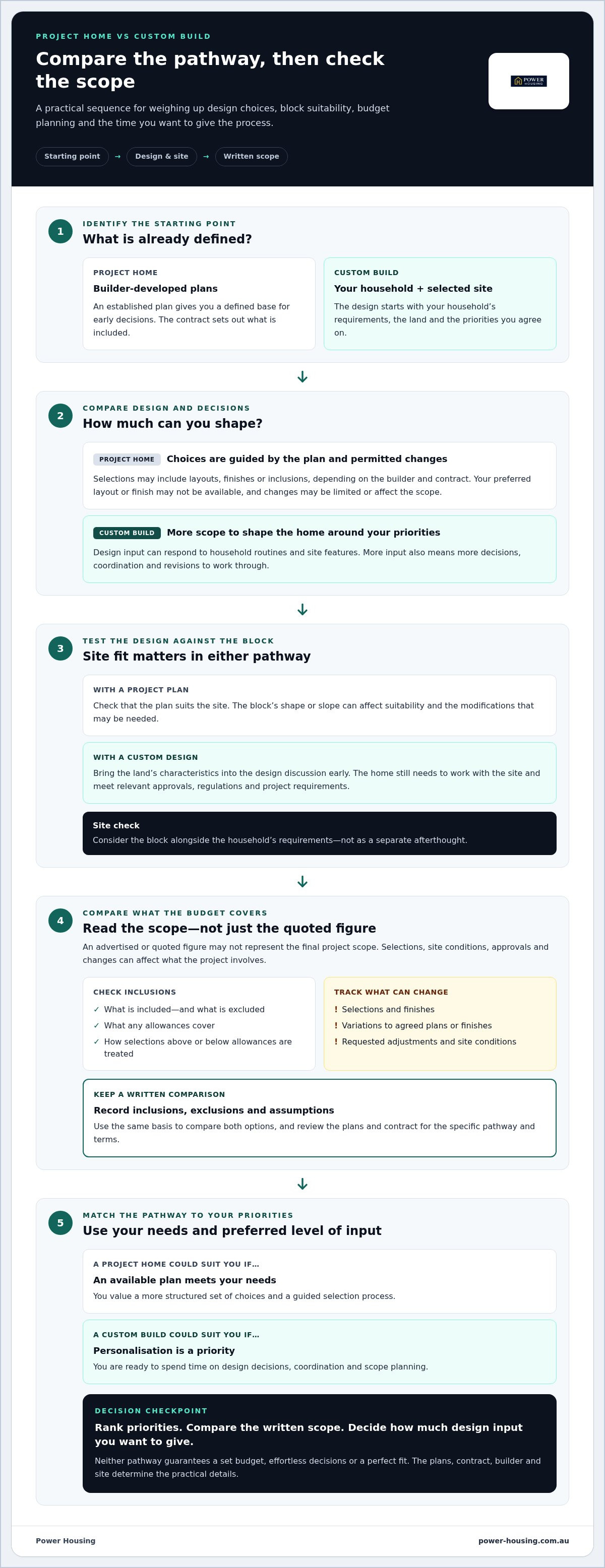
The main difference is the starting point. A project home uses plans a builder has already developed. A custom build starts with your household’s requirements and the selected site. The distinction is not always absolute: the choices, permitted changes and design process depend on the builder and contract.
Both pathways involve decisions about how a home will suit your household and block. To compare the project home vs custom build pros and cons, find out what is already defined and what can be changed. The Housing Industry Association (HIA) provides background on an organisation associated with Australia’s residential construction industry. The plans and contract for your project set out its specific pathway and terms.
At a glance
- Starting point: An existing plan, or a design developed around your requirements and site.
- Design control: Usually shaped by the available plan and permitted changes, or by agreed design priorities.
- Choices: May include plan, finish or inclusion selections, depending on the builder and contract.
- Buyer decisions: Often guided by a defined selection process, or involve more design input and coordination.
What does a project home usually involve?
A project home starts with plans a builder has already developed. This gives you a defined base for early decisions. A selection process may help you compare layouts and choose from available finishes, but options vary between plans and builders. The contract sets out what is included.
Changes may be limited or subject to conditions. The block matters too. A plan needs to suit the site, and features such as its shape or slope can affect its suitability and the modifications that may be needed.
What makes a custom build different?
A custom build starts with your household’s needs, the characteristics of your selected land and the priorities you agree on. This can give you more scope to shape the layout around how you live. It also means more decisions and design coordination as the plans develop.
Custom design still has constraints. The home needs to work with the site and meet relevant approvals, regulations and project requirements. Considering land selection and home design together can bring these factors into the conversation early, so the design responds to both the block and your requirements.
Project home vs custom build pros and cons for everyday buyers
Neither pathway guarantees a set budget, effortless decisions or a perfect fit. A project home may have a more guided selection process; a custom build may allow more design input. What you receive depends on the plans, contract, builder and site. Compare the documented scope, not just the label.
To understand the budget, check what is included and what could change. Selections affect the final scope, and variations may arise if you change agreed plans or finishes. If the contract uses allowances, check what they cover and how selections above or below them are treated. Keep a written record of inclusions, exclusions and assumptions so you can compare options on the same basis.
Project home
- Benefit: Established plans and a guided selection process can make early choices more manageable.
- Trade-off: Your preferred layout or finish may not be available, and changes may be limited or affect the scope.
- Buyer fit: Could suit you if an available plan meets your needs and you value a more structured set of choices.
Custom build
- Benefit: Design input can respond to household routines and site features, such as the direction living areas face.
- Trade-off: More input can mean more decisions, design coordination and revisions to work through.
- Buyer fit: Could suit you if personalisation matters and you’re ready to spend time on design decisions and scope planning.
Project home advantages and trade-offs
An established plan gives you a starting framework. A defined selection process may help organise decisions about finishes and other available choices. But the plan still needs to suit your block, and the contract determines what is included and which changes are permitted. Site conditions or requested adjustments can affect the final scope, so choosing a familiar plan does not guarantee an unchanged project.
Custom build advantages and trade-offs
Custom design can make room for specific priorities, from storage for a busy household to a layout that responds to the block. That control comes with more decisions: choices and revisions take time, and design changes can affect the scope. Set priorities early, then separate essential features from optional ones. First-home buyers can also use the Australian Government’s information on government assistance for home buyers to inform broader budget planning.
To consider land and design together, explore tailored house and land packages.
Compare design freedom, site fit and budget planning before you choose
A fair comparison uses the same questions for both pathways. Look beyond an advertised or quoted figure, which may not represent the final project scope. Site conditions, selected finishes, approvals and changes can all affect what the project involves. For general Australian construction industry context, see Master Builders Australia.
Comparison matrix
- Block fit: For a project home, assess whether an existing plan suits the site. For a custom build, consider how the design can respond to its characteristics.
- Layout changes: For a project home, compare the available plans and permitted modifications. For a custom build, define the layout around household priorities and the selected block.
- Selection choices: For a project home, review the finishes and options offered under the builder’s terms. For a custom build, allow for decisions to develop as the design takes shape.
- Time input: A project home’s defined selection process may guide decisions. A custom build may require more time for design choices and coordination.
- Budget management: For either pathway, compare inclusions, exclusions, allowances and variation processes in writing. Consider site-specific requirements before treating options as like-for-like.
Neither build type guarantees a fixed final cost without clear scope and contract terms. A quoted or advertised figure is useful only when you know what it covers, what is excluded and how selections or changes are handled. Keep those details with the plans so you can compare proposed projects on consistent terms.
How much design control do you need?
Before comparing plans, sort your requirements into three groups: must-haves, preferred features and flexible choices. An existing plan may offer selectable options, subject to the builder’s terms, but a specific room arrangement or finish might not be available. A tailored design may suit you better if your household has distinctive needs or the block calls for a particular response.
How can you compare budgets and site suitability?
Review the written scope for each option, including inclusions, exclusions, allowances and the variation process. Then check whether the plans respond to the same site conditions. For example, a design that needs substantial adjustment to suit the block is not directly comparable with one that fits its characteristics more closely. Include applicable approvals and requirements in your feasibility assessment, as these can depend on the project and its location.
This side-by-side check turns the project home vs custom build pros and cons into practical questions: which design fits your block, which choices matter most, and how clearly can you understand the project scope?
Which build pathway suits your block, budget priorities and lifestyle?
Turn the comparison into a practical decision. The project home vs custom build pros and cons matter most when weighed against your household’s needs, your land and the time you can give to design decisions. Use these four steps to narrow your options.
- Rank your priorities. List must-have rooms, accessibility needs, storage and everyday-use requirements. Separate them from preferred features and flexible choices.
- Assess the block. Consider dimensions, orientation, slope and access, along with any planning controls that may apply. A design that suits your lifestyle still needs to work on the land.
- Compare the scope. Review written plans, specifications and contract scope rather than relying on labels or headline descriptions. Note where the options differ.
- Review your decision capacity. Consider how much time and input you want to give to selections, design choices and possible revisions.
Use your priorities to narrow the options
Be specific about how you’ll use the home. You might need a quiet work area, accessible movement between key rooms or extra storage for family activities. Decide what could change if a preferred plan does not fit the block. The more changes you want, the more design input you may need. A project home may suit you if an existing plan meets your needs and you value defined choices. A custom build may be worth considering if site-responsive design and personalisation are priorities, and you’re comfortable taking part in more decisions.
Assess the land and project scope together
Consider the block and design as a pair. Orientation may influence how rooms relate to sunlight and outdoor areas. Slope, dimensions and access can also shape what is practical. Planning controls and approval details vary across Australia, including between state, territory and local contexts. Base your comparison on the actual site and project documents, not assumptions drawn from another block or a similar-sounding offer.
The best fit depends on your priorities, site conditions, project scope and comfort with decisions. If you’re weighing land and design together, explore tailored house and land packages as a coordinated way to consider a home alongside your requirements and selected site.
Bring land and home design together with a tailored pathway
Land and design decisions are closely connected. A block can shape what feels practical, while your household’s needs can guide the type of site and residential design to consider. This joined-up view adds context to the project home vs custom build pros and cons. Instead of choosing a plan first and treating land as a separate decision, consider how each may work with the other.
When a tailored house and land package may make sense
A coordinated pathway may suit buyers who want to consider a residential design alongside a suitable land opportunity. For example, a preference for a single-level layout, extra storage or a dedicated work area can inform the conversation about what kind of block may work for those plans. Power Housing coordinates tailored house and land packages and provides custom home design assistance, helping connect land selection with your household requirements.
The aim is to consider the project as a whole. Land characteristics and design priorities can be weighed together, with scope and design details shaped around the individual project. This gives you a clearer basis for deciding which requirements are essential and where you may have room to adapt.
Take your next step with a clear brief
Prepare a short, practical brief before exploring options:
- Household needs: Rooms, storage and everyday-use requirements.
- Preferred features: The design details you value most, alongside those you could reconsider.
- Budget priorities: What matters most when planning the overall project scope.
- Timing considerations: Personal plans that may affect your decisions.
A clear brief gives land selection and design discussions a useful starting point. It also helps distinguish must-haves from preferences as you consider how a home could suit the site and your lifestyle. Power Housing brings tailored house and land coordination together with custom home design assistance as you shape that pathway.
Ready to explore a coordinated approach? Explore tailored house and land options with Power Housing.
Choose a pathway that fits your plans
The project home vs custom build pros and cons become clearer when you focus on what matters to your household. A project home may suit you if an existing plan fits and you prefer defined choices. A custom build may be a better match if you value a design shaped around your requirements and selected site, and are ready to take part in more decisions.
Before committing, compare the written scope, inclusions and exclusions, and consider how the design responds to your block. Your comfort with decisions matters too. There is no universal winner, only a pathway that aligns with your priorities, site and preferred level of design input.
Power Housing coordinates tailored house and land packages and provides custom home design assistance to help bring land and household requirements together. If you’re ready to explore that approach, explore tailored house and land options with Power Housing.
Take the next step with a clear brief and a confident sense of what you want your new home to do for you.
Frequently Asked Questions
What is the main difference between a project home and a custom build?
A project home generally starts with an established plan and a builder-defined selection process. A custom build begins with a design shaped around your requirements and site. The amount of choice is not fixed by these labels: plans, permitted changes and selections vary according to the builder and contract. Compare the written scope, including inclusions and exclusions, to understand what each pathway involves for your project.
Is a project home cheaper than a custom build?
Not automatically. The final project scope can depend on the land, site conditions, design, inclusions and any changes. A project home may provide a more defined starting point, while custom design can involve different specifications and decisions. To compare budget fit, review the written inclusions, exclusions, allowances and variation terms for each option. An advertised or quoted figure alone may not describe the complete project.
Can you customise a project home?
Some project-home plans allow selections or changes, while others limit modifications or set conditions for them. Options vary between builders, plans and contracts, and changes may affect the design, approvals or project scope. Start by listing essential adjustments, such as a different room arrangement or extra storage. Then compare that list with the plan documents and written terms to see how well the pathway matches your needs.
Is a custom build worth it for a difficult block?
A custom build can be worth exploring if the block’s shape, slope, orientation or other characteristics call for a tailored design response. It is not automatically the right choice: feasibility depends on the site, your design brief, planning controls and overall scope. Consider the land early and account for applicable planning and building requirements in the relevant state or territory before settling on a design pathway.
Which takes longer, a project home or a custom build?
There is no universal timeframe. Design development, selections, approvals, site conditions, contract requirements and construction can all affect the schedule. A project home may start from an established plan, while a custom build may involve more design decisions before construction. Compare the proposed milestones and dependencies for the specific project rather than assuming one pathway is always faster. Changes during planning may also affect the schedule.
Can I get a house and land package with a custom design?
Yes. A coordinated house and land pathway can bring land selection and home design into the same planning conversation. The design approach and choices depend on the individual project and household requirements. Power Housing coordinates tailored house and land packages and provides custom home design assistance, helping buyers consider how a residential design can align with selected land and their needs.
What should I compare before choosing a builder or build type?
Compare the plans, design scope, inclusions, exclusions, allowances, variation process and site-related requirements in writing. Consider how the proposed design responds to your block and household, and how decisions will be documented. Also assess how much time and input you want to give to design choices. The project home vs custom build pros and cons are easier to weigh fairly when you compare the documented scope, not just the headline label.


